More here!
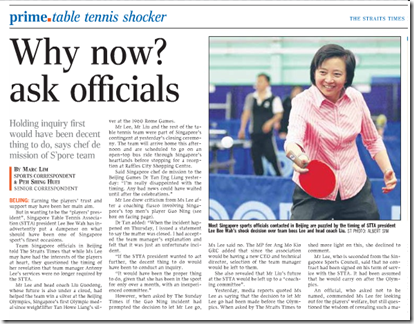
FURIOUS Singaporeans lambasted the shock decision by table tennis president Lee Bee Wah to remove team manager Antony Lee and to refer the fate of Liu Guodong, the team’s head coach, to a coaching committee.
By 8pm yesterday, The Straits Times received nearly 200 e-mails and letters from readers - almost all of whom voiced disbelief and outrage. Many more flamed Ms Lee in Internet blogs and postings.
Most of them took issue with the timing of the news, which came just before Singapore’s Olympic paddlers were due for a victorious homecoming this afternoon.
‘This sudden announcement has certainly cast a dark cloud over the shining achievements of the table tennis team,’ banker David Chee lamented.
‘Just as people should be given time to mourn their loss, they should also be given time to celebrate their achievements. Anything short of this is just plain disrespectful.’
Mr Lee was held responsible for Gao Ning’s third-round defeat in the men’s singles at the Games. Gao, the Republic’s top male paddler, had to play without a coach by his side.
The Register-Guard
Published: August 14, 2008 12:00AM
Sol Neelman/For The Register-Guard
Wu Jia Mu Wa, 9, practices table tennis at the Beijing Shichahai Sports School. He hopes to one day win a world championship.
BEIJING — One after another, the plastic balls rocket through the air. Impossibly fast, the players fire balls back and forth, and you realize:
This is not your basement ping pong game.
It’s also not the Olympics. Those guys are much better. These tiny kids we’re watching at the Beijing Shichahai Sports School, they’re “OK,” says a coach. “For their age.”
Which is why, when you get to the Olympic table tennis venue, across town at the Peking University Gymnasium, you see the intensity from the fans in the packed house. You check out the rosters — 40 of 48 women’s players are from China. And you realize at least in one category, China’s desire for world domination has been achieved.
Ping pong diplomacy?
Last weekend, President Bush was here for the Olympics. He issued some blunt statements about human rights issues in China, and he met with Chinese President Hu Jintao, where they apparently discussed the same issues.
Let’s hope they didn’t agree to settle things with a friendly game, because Hu has a reputation as an above-average player. And you should know, says Team USA’s David Zhuang, who grew up in China:
“Here, if you say you can play, you can really play.”
In recent years, the Chinese have gone crazy for basketball. They love badminton, they like volleyball, and soccer is very popular.
But, says Zhuang, “there is always table tennis.” Back in the 1950s, Mao Tse-Tung proclaimed it the national sport, and it’s deeply woven into the cultural fabric.
To understand why China dominates the sport, leave the Olympic gymnasium and find the nearest park, and watch people playing on concrete tables. Think basketball in America’s inner cities, with pickup games running nonstop, and you’ve got a rough idea what it’s like. Or in a more recent development, go to one of the many ping pong clubs, where for a small fee, you can grab a table and find a game.
You’d better bring a good game, though, because everyone here has one.
Zhuang says nine of 10 people on a Beijing street will tell you they play ping pong. He’s exaggerating, but the estimates on recreational players start at 200 million. More than 10 million are registered (like a tennis rating or a golf handicap), and 4 million are tournament players (the United States has 4,000).
For more on world domination, we travel across town to the sports school, where children train year-round in eight sports — 3½ hours a day, 6½ days a week, with Saturday afternoons off — part of China’s official emphasis on developing athletic potential.
In the ping pong hall, children are practicing ping pong on 18 of 25 tables. The game’s familiar clip-clop, clip-clop, clip-clop instead sounds like CLIPCLOPCLIPCLOPCLIPCLOP — unfortunately, it cannot be written or read fast enough or loud enough for an accurate description.
As a coach feeds balls, 9-year-old Wu Jia Mu Wa slides back and forth, easily smacking the ball to precise places on the table. During a break, he says he loves ping pong, and when you ask his goal, he points to a photograph of Olympic gold medalist Zhang Yining, a graduate of the school.
“I want to win the world championship,” Wu says through an interpreter, and watching him, it sure seems he could. A foreign reporter challenges the kid. She’s played the game before and she’s pretty good, but Wu toys with her, ending points whenever he wants.
The coach, an older woman named Liu Ya Chin, isn’t ready to project greatness.
“He’s still young,” she says, also through an interpreter. “It all depends on how he develops. There are so many factors. There are so many people playing ping pong in China.”
That last part is the biggest key. Recall the 4 million tournament players? Maybe 700 are good enough to make the roster of one of 33 province-level teams. The national team is selected from that pool.
Team USA’s Gao Jun worked her way up through the system. Sports school in Baoding at age 5, the Hebei province team at age 11, the national team at 16.
She won a silver medal in Barcelona in 1992, and emigrated two years later to the United States.
“China has so many good players,” Gao says. “When I said I wanted to leave the team, they said, ‘OK.’ They don’t care if you want to leave the team, because there are so many behind you.”
When someone asked Gao on Tuesday whether the Americans could close the gap on the Chinese, she just laughed for a minute. The U.S. women had just lost to Singapore — the No. 2-ranked team, with a roster that’s entirely Chinese. It wasn’t close. Gao was blunt.
“We all played OK. But they are so much better.”
This isn’t your basement. This is ping pong hegemony.
HHHH
George Schroeder can be reached at george.schroeder@registerguard.com. His updated blog from the Olympics is at registerguard.com/olympics.


